Expedia clone development: build a focused travel platform
An Expedia-style platform starts with a clear travel business model, dependable inventory and a complete booking journey—not a copied homepage.
 Altsoft Editorial TeamTravel platforms & systems integration
If you are searching for Expedia clone development, the useful starting point is not a screen-by-screen copy. It is an independent travel platform that helps a defined group of customers find, compare and book the travel products you can reliably fulfil. Your branding, content and commercial proposition should be your own.
For an online travel agency, the difficult decisions often sit behind the search box: which inventory you can sell, who confirms a reservation, who collects payment and who helps when plans change. Altsoft approaches the project as a booking operation supported by software, with a launch scope that can be tested from beginning to end.
Choose the business model before the feature list
Start by deciding whether customers will complete a booking on your platform or follow a referral to another seller. An enquiry-led agency, an affiliate comparison site and a full transactional OTA have different responsibilities. A polished search page cannot remove those differences.
Write a one-page brief describing your first customer segment, launch destinations, product category, source of inventory and support model. A hotel-first agency serving one market may need fewer integrations than a platform offering flights, accommodation and activities across many countries. More categories are not automatically a better first release.
Use DownFare as a concrete interface example
Altsoft's DownFare portfolio project demonstrates separate hotel and flight search journeys within one travel interface. The screenshot below shows the flight entry point, where origin, destination, dates and travellers are distinct inputs.
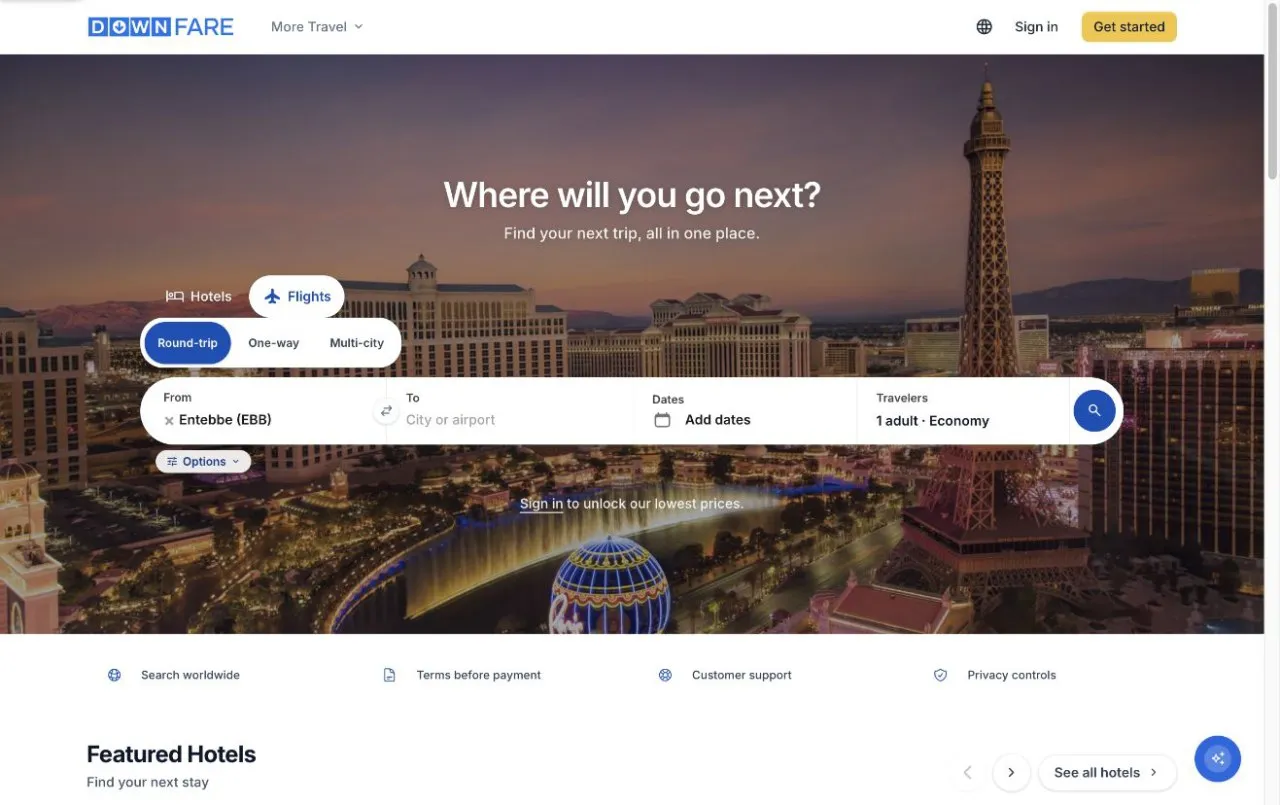
Public DownFare interface captured on 9 November 2026. This is a portfolio sample, not evidence of a particular supplier contract, live inventory entitlement or commercial result.
The design lesson is to ask for the information needed for that product. Hotel occupancy and flight passenger details should not be forced into an identical form simply to make the navigation look consistent. Compare the sample with DownFare's current public website; its interface may change over time.
Separate supplier access from development
Travel inventory is not included merely because a website has been built. Supplier agreements, permitted markets, payment arrangements and production approval should be checked before a development team commits to launch dates.
For example, Expedia Group's Rapid setup guide requires partner approval and a site review before production use. Hotelbeds and Amadeus have their own commercial and technical routes. The appropriate combination depends on your business; a supplier logo is not a substitute for confirmed access.
Define one complete minimum viable booking journey
A useful first release should complete a real customer task, not merely demonstrate several disconnected search screens. Specify the following journey and agree who is responsible for each step:
- Search for the intended dates and traveller composition.
- Show suitable results with a clear total and relevant conditions.
- Revalidate the selected option through the supplier's required flow.
- Collect the necessary traveller details and process the agreed payment step.
- Obtain a confirmed supplier reference and send a usable confirmation.
- Allow the support team to retrieve, investigate and service the booking.
Include failure paths in the demonstration: a changed price, an unavailable option, a delayed response and a customer returning after payment. A payment success screen must not be used as proof that the supplier confirmed the trip.
Make the operational dashboard part of the product
Your team needs searchable reservations, payment references, supplier references, customer messages and a clear queue for unresolved issues. Access should follow staff roles. Sensitive traveller information should not be copied into general support notes or unrestricted logs.
Ask for an acceptance checklist, not only a list of pages. Can an agent find a booking using the customer's reference? Can they distinguish a pending payment from an unconfirmed reservation? Can they see which action was taken and by whom? These questions make the implementation measurable without inventing a promised sales increase.
Plan discovery and conversion around a real audience
Use useful destination or travel-service pages where you have something specific to offer. Explain your booking model, support arrangements and proposition. Avoid filling the site with near-identical destination pages or copying supplier descriptions without adding useful context. Clear mobile forms and honest conditions help prospective customers decide whether to proceed.
Discuss an Expedia-style platform with Altsoft
Bring your intended markets, supplier-access status, first product category and launch priorities. Altsoft can help shape the customer journeys, administration tools and API integration scope into a phased implementation brief. Request a travel-platform consultation and mention this guide so we can start with the right questions.
Expedia is referenced to describe a familiar product category. Altsoft and the featured portfolio examples are not presented as affiliated with or endorsed by Expedia.
Related resources
Services, project examples and practical guides.
Put these ideas to work.
Talk through your workflow with an Altsoft specialist and decide on your next step.